

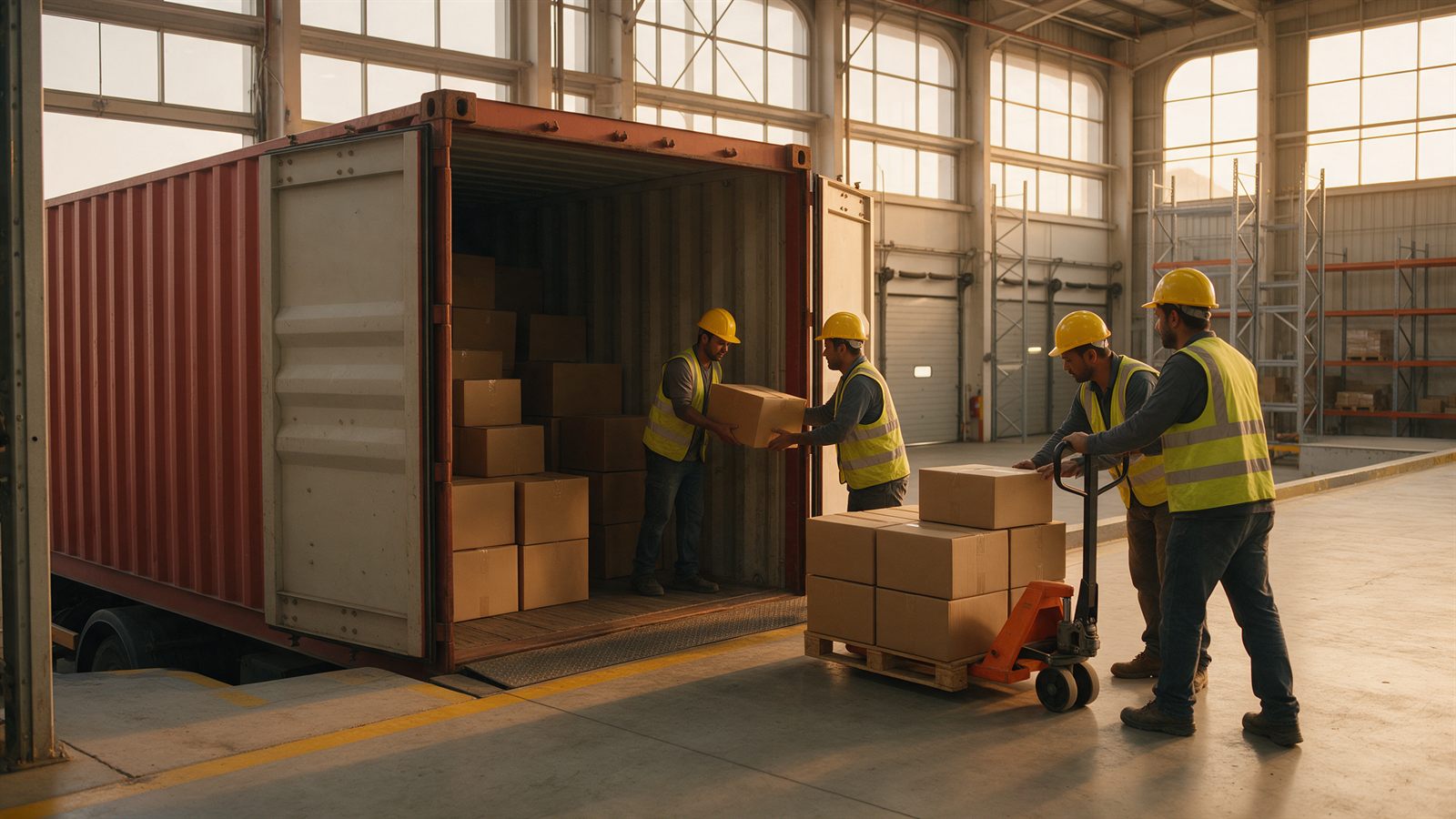
Storing imported goods in Dubai is about more than finding space for a container. Once a shipment arrives, someone has to unload it, count it, check it for damage, label it and put it somewhere it can be found again. If those steps are rushed, the problems show up weeks later as missing stock, wrong orders and unhappy customers.
This guide follows imported stock from arrival at the warehouse to organised storage and onward distribution. It is written for importers, distributors and brands bringing products into the UAE who want their stock ready to sell, not just sitting in a pile.
Why storing imported goods in Dubai needs a plan
Imported shipments often arrive in one large delivery, sometimes a full container of mixed cartons. Unlike small daily replenishments, there is little room to sort things out later. The first hours after arrival decide how accurate your stock records will be.
Many businesses use one Dubai warehouse to serve local retailers, online orders and trade customers. The same stock may be called on by several channels, which makes clear, organised storage even more important.
Common problems when there is no plan
- Cartons stacked without labels, so nobody knows what is inside
- Quantities never checked against the packing list
- Damaged cartons discovered only when a customer order is picked
- Several SKUs mixed in one location, causing picking mistakes
- Stock moved around without records being updated
Before the shipment arrives
Good receiving starts with information shared in advance. Your warehouse team should know what is coming, roughly when, and how it is packed. A short checklist helps:
- An advance notice with the expected arrival date
- A packing list showing SKUs and quantities per carton
- Whether the goods are palletised or loose-loaded in the container
- Product barcodes or SKU codes, and any labels still needed
- Handling notes for fragile, heavy or heat-sensitive items
- Instructions for stock that must be held, inspected or split on arrival
Customs clearance and import documentation are separate from warehousing. For questions about duties, import permits or product registration, speak to your customs broker or the relevant authority before the goods ship. Keep copies of your shipping paperwork to hand, as they help when checking what has arrived.
Receiving and counting imported stock
When the container or delivery truck arrives, the goods are unloaded and checked. Loose-loaded containers take longer to unload than palletised loads because each carton is handled individually, so it helps to tell the warehouse in advance.
Counting against the packing list
Each carton or unit is counted and compared with the packing list. Shortages, overages or damaged cartons should be recorded straight away, ideally with photos. That gives you the evidence you need to raise the issue with your supplier or forwarder.
Scanning at receiving
At Enthusiasm 3PL, stock is scanned with barcode scanners at receiving, put-away and picking. Scanning at the receiving stage means the inventory record matches what physically arrived, rather than what the paperwork said should arrive.

Labelling, put-away and organised storage
Imported products do not always arrive with labels that work for local retail or online channels. Before put-away, you may need SKU labels, carton labels or relabelling to match your own system. Requirements vary by retailer and marketplace, so confirm them with each one. Our value-added logistics service covers labelling, repacking, bundling and consolidation.
Choosing the right storage format
Full pallets of reserve stock suit palletised storage. Cartons and loose units that are picked often suit racked locations that are easy to reach. Heat-sensitive products can be discussed for temperature-controlled storage, with product requirements reviewed and agreed during quotation.
| Type of stock | Typical storage approach | Notes |
|---|---|---|
| Full pallets of one SKU | Palletised storage | Suits reserve stock and bulk replenishment |
| Mixed cartons | Racked locations by SKU | Split mixed pallets on arrival so each SKU has its own location |
| Small, fast-moving items | Easy-reach racked locations | Makes picking for online orders simpler |
| Heat-sensitive goods | Temperature-controlled room | Requirements agreed during quotation |
| Fragile or high-value items | Clearly labelled, controlled locations | Agree handling notes in advance |
Location labelling
Every storage location should have a label, and every SKU should be scanned into its location. That way stock can be found quickly and counted accurately, even months after the shipment arrived. Our warehouse storage offers both racked and palletised formats, and our guide to inventory management for UAE businesses explains how to keep records accurate over time.
From storage to distribution
Once imported goods are organised, they are ready to move. Most importers use the same stock pool for several types of order:
- Retailer replenishment: full or mixed cartons sent to stores on a schedule
- B2B orders: distributors, trade customers, promotions and project stock
- E-commerce orders: single items picked, packed and handed over for delivery
- Marketplace stock: products and cartons prepared for Amazon.ae or Noon fulfilment centres
Enthusiasm 3PL delivers with its own trucks for orders such as retailer and trade deliveries. Our B2B fulfilment service handles full-carton, mixed-carton and multi-SKU orders with scheduled dispatch. For a closer look at how wholesale and online orders differ, read B2B vs B2C fulfilment.
Not every shipment needs long-term storage. Some goods can be cross-docked: received, sorted and sent straight out to customers. Others are consolidated with existing stock before dispatch. Talk through your order pattern with your 3PL so the right approach is agreed from the start.
Frequently asked questions
Who handles customs clearance for imported goods?
Customs clearance is usually arranged by your customs broker or freight forwarder. Warehousing begins once the goods are delivered to the warehouse. For any import requirements, check with your customs broker or the relevant authority.
What should I send the warehouse before a container arrives?
Send the expected arrival date, the packing list, SKU and barcode details, and any handling notes. The more detail you share, the faster and more accurate receiving will be.
Can mixed cartons be sorted by SKU on arrival?
Yes, sorting mixed cartons into separate SKU locations is a normal part of receiving and put-away. Let the warehouse know in advance if a shipment is mixed so enough time can be planned.
How do I start storing imported goods in Dubai with a 3PL?
The usual steps are an inquiry, a quotation, documentation, account setup and then the start of operations. Having your SKU list, expected volumes and shipment schedule ready helps the provider prepare an accurate proposal. Our warehouse storage guide covers the storage options in more detail.
Final thoughts
Storing imported goods in Dubai works well when each shipment follows the same path: advance notice, careful counting, scanning, labelling and organised put-away. Get those steps right and your stock is ready for retailers, online customers and marketplaces whenever orders arrive. Enthusiasm 3PL has operated as a warehousing company in Al Quoz Industrial Area 2 since December 2016, with racked, palletised and temperature-controlled storage.
Have a shipment on the way? Share your packing list, SKU count and expected volumes and we’ll prepare a tailored storage proposal. Request a quote.